On July 8, 2026, in Hanoi, Deputy Governor Nguyen Ngoc Canh of the State Bank of Vietnam (SBV), attended and delivered remarks at the seminar entitled “Double-Digit Growth – Driven by Enterprises,” organized by Nhan Dan Newspaper and the Vietnam Chamber of Commerce and Industry (VCCI).
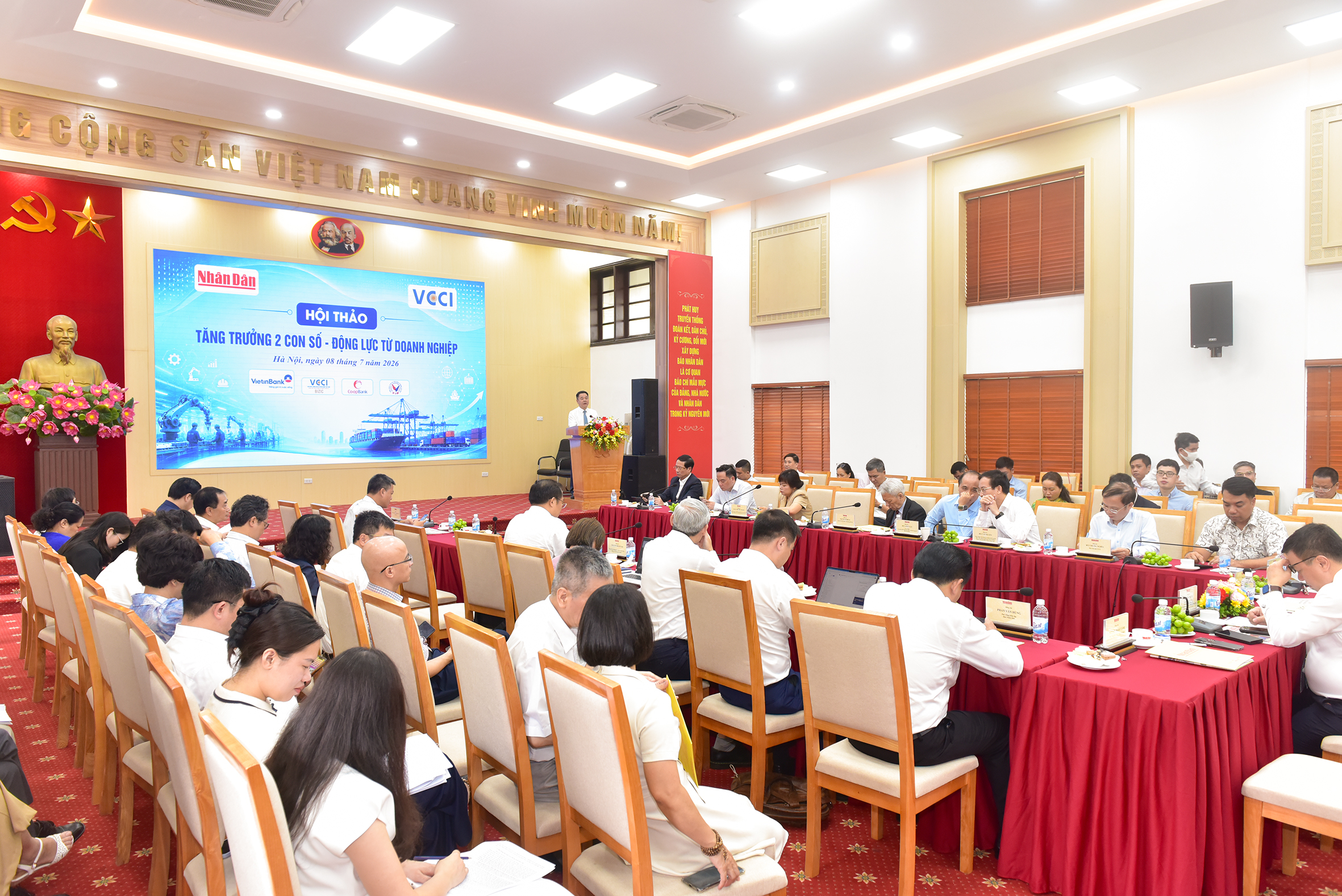
Overview of the Seminar
In his remarks, Deputy Governor Nguyen Ngoc Canh affirmed that, as the principal provider of capital to the economy, the banking sector remains committed to accompanying and supporting the business community in achieving the development goals set by the Party and the State. He noted that the banking sector continues to advance institutional reform, digital transformation, and the application of science and technology, while implementing a broad range of monetary and credit policies to remove bottlenecks and unlock resources for enterprises to invest and expand production, thereby contributing to economic growth.

Deputy Governor Nguyen Ngoc Canh speaks at the Seminar
Regarding credit management, the Deputy Governor noted that the SBV sets an annual credit growth target with sufficient flexibility to make appropriate adjustments in line with economic conditions, with the target for 2026 set at 15%. The SBV has also directed credit institutions to expand lending in a safe and effective manner, prioritizing production and business activities, priority sectors, and key growth drivers, while implementing credit programs for agriculture, forestry, fisheries, and social housing.
To promote private sector development, the Deputy Governor stated that the SBV has submitted to the Government a draft decree on a 2% interest rate support package, financed by the state budget, for private enterprises, business households, and individual business owners borrowing from commercial banks to implement green and circular economy projects and projects applying environmental, social, and governance (ESG) standards. The SBV has also submitted the National Financial Inclusion Strategy for the 2026–2030 Period to the Prime Minister and proposed new regulations on financial leasing that would expand eligible leased assets to include software, exploitation rights, intellectual property, and data.
In addition, the SBV has launched a VND 500 trillion credit package to support investment in infrastructure and digital technology. Credit institutions have been directed to strengthen financing for enterprises and business households participating in value and supply chains, while prioritizing lending to private enterprises, particularly small and medium-sized enterprises (SMEs), supporting industries, and innovative start-ups investing in machinery, equipment, advanced technologies, green transition, and digital transformation.
As of June 26, 2026, total outstanding credit in the banking system exceeded VND 19,9 quadrillion, up 7.41% compared with the end of 2025. Outstanding credit to the private sector surpassed VND 18.2 quadrillion, accounting for 92.6% of total outstanding loans. Credit extended to enterprises reached approximately VND 10.5 quadrillion, equivalent to 53.3% of total outstanding credit, of which loans to private enterprises amounted to VND 9.1 quadrillion, representing 86.7% of total corporate lending.

Participants at the Seminar
The Deputy Governor also proposed a number of key measures to help achieve the double-digit growth target, including removing institutional bottlenecks, mobilizing and allocating resources efficiently, developing a transparent, safe, and sustainable capital market, promoting science, technology, innovation, and digital transformation, improving human resource quality, and boosting domestic consumption, exports, market expansion, and value-added production.
The seminar featured two thematic discussion sessions entitled “Substantive Reduction of Business Conditions” and “The Private Sector: The Core of the Growth Strategy.” Discussions focused on institutional reform, improving the business environment, and expanding access to development resources with a view to generating practical policy recommendations for private sector development in the new period.